
Why the Mark Carney Government is a Disaster
Prime Minister Mark Carney has made numerous terrible decisions - including gutting Canada’s climate change measures, moving to expand oil sands production, and supporting Donald Trump’s illegal and disastrous war on Iran
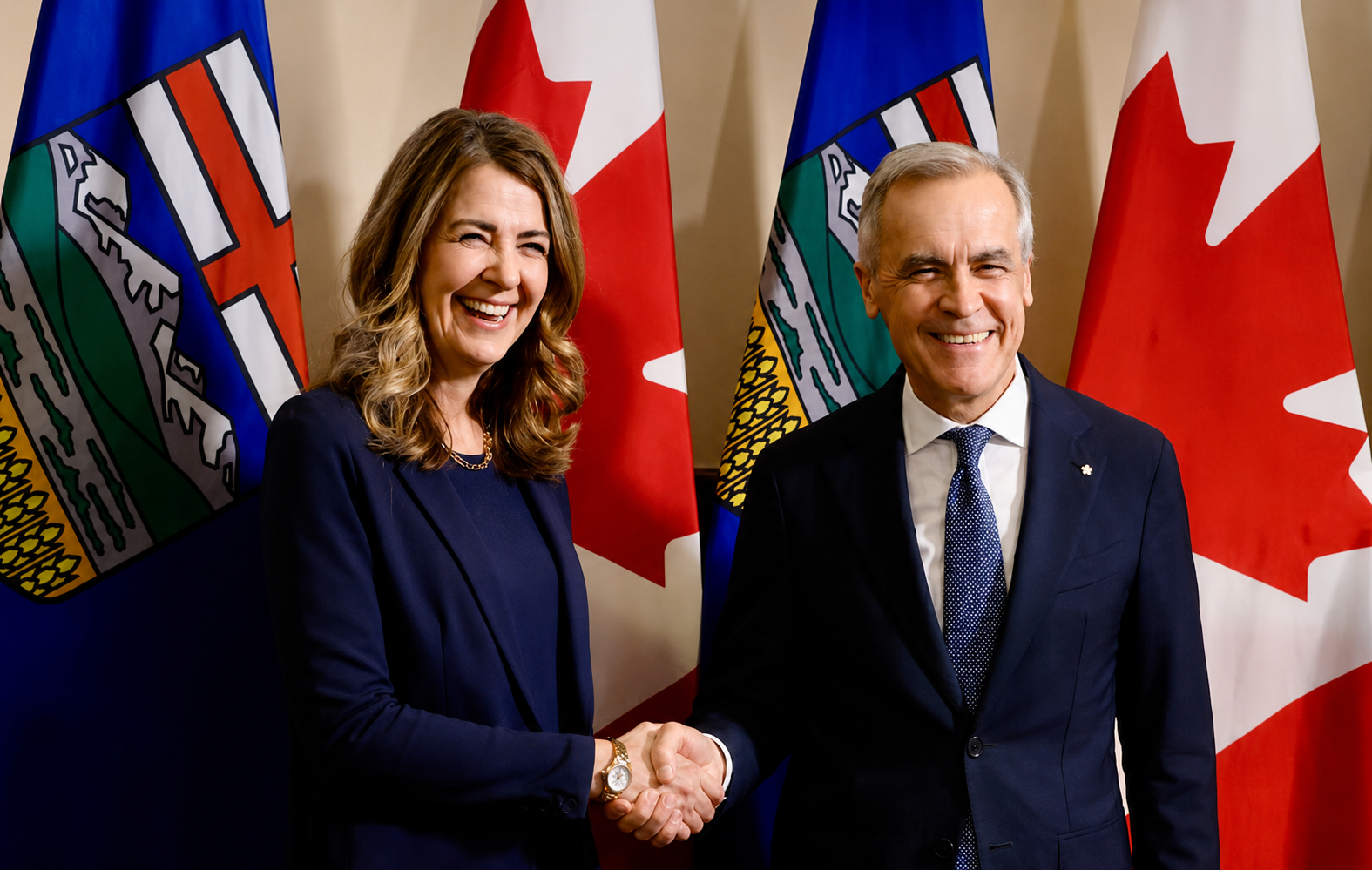
Mark Carney and Alberta Premier Danielle Smith meeting in May 2026 to announce an agreement to build a new oil pipeline from Alberta to the West coast
Since taking office in 2025, Mark Carney's Liberal government has made a series of disastrous decisions and moves.
These include:
Gutted Canada’s Climate Policies while Encouraging Fossil Fuel Production - just as Global Warming Accelerates
Carney significantly altered Canada's climate policy framework – ensuring the country will not meet its Paris Agreement targets by a long shot.
Perhaps the most dramatic policy reversal was the elimination of the federal consumer carbon tax. The carbon pricing system had been the centrepiece of Canada's emissions reduction strategy since 2019. Economists broadly regarded carbon pricing as one of the most cost-effective ways to reduce greenhouse gas emissions by encouraging consumers and businesses to choose cleaner alternatives. Environmental experts warned that removing it eliminated one of Canada's strongest incentives to reduce fossil fuel consumption.
The government has also weakened proposed regulations designed to limit emissions from Canada's oil and gas industry. Under the previous Liberal government, Canada had planned to impose a cap on greenhouse gas emissions from the sector, which is responsible for roughly one-third of the country's total emissions.
Carney's government suspended and later abandoned the emissions cap as part of broader negotiations with Alberta aimed at increasing investment and easing tensions with energy-producing provinces. Environmental organizations viewed this decision as a major setback because the oil and gas industry remains Canada's largest and fastest-growing source of greenhouse gas emissions. Without enforceable limits, critics argue that emissions from the sector could continue rising even if other parts of the economy become cleaner.
Another controversial shift has been the government's increased support for oil and gas infrastructure. Despite earlier expectations that Carney would focus on accelerating the transition toward renewable energy, his administration has expressed openness to new pipeline projects and has sought to speed up approvals for major resource developments. In early 2026, his government signed an agreement with Alberta to build an oil pipeline from that province to the West coast – which will accelerate development of the oil sands and significantly increase carbon emissions.
The Carney government has also reduced or eliminated several financial programs intended to encourage Canadians to reduce their carbon footprint. Funding for electric vehicle purchase incentives and home energy retrofit programs has been scaled back compared with previous commitments. These programs had helped households purchase electric vehicles, improve insulation, install heat pumps, and reduce energy consumption.
Critics have also expressed disappointment with the government's broader approach to sustainable finance. Analysts argue that Canada has fallen behind several peer countries in implementing comprehensive sustainable finance policies.
By eliminating consumer carbon pricing, abandoning planned emissions caps, reducing clean-energy incentives, supporting expanded fossil fuel infrastructure, and slowing the implementation of sustainable finance reforms, the government has shifted Canada's climate strategy that will ensure that C02 emissions climb instead of fall.
Supported Donald Trump’s Illegal War on Iran
At the outset of the 2026 U.S.-Israeli military campaign against Iran, Carney publicly expressed support for the strikes – despite the fact that the attack was without provocation and violated international law. Carney was one of only a small handful of global leaders to back Trump’s war. Carney said Canada supported the U.S.-Israeli action to destroy Iran's nuclear program, describing Iran as a major source of instability in the Middle East.
In the days that followed, Carney initially said Canada would not rule out military involvement alongside allies if circumstances warranted.
This disastrous war has led to rising energy costs, threats of a global recession and expanding tensions and attacks throughout the Middle East.
Cut Government Spending - Except on the Military
Since taking office in 2025, Carney has directed federal departments to cut billions and implement hiring controls. Critics argue these measures weaken public services and climate programs.
At the same time, Carney is significantly increasing defence spending, adding an additional $9-billion to $10-billion annually to the military’s budget - money that could be better used to creating a zero emissions economy and alleviating the declining standards of living of working people.
Backed the Expansion of Billy Bishop Toronto City Airport to Permit Jets
When the Doug Ford government announced it was planning to expand the Billy Bishop Toronto City Airport to allow jets to land on it - at the behest of a subsidiary of an American bank, J.P. Morgan, which owns the terminal - Carney immediately supported the idea. This despite the fact the expansion would have caused more pollution, noise and traffic jams along Toronto’s waterfront.
Then Toronto’s residents rose up in protest. Facing vocal opposition, Carney reversed his support for the airport expansion - yet held the door open for approving it down the road.
Rolled Back Levies and Taxes on Major Tech Firms
Carney’s government rescinded the planned 3% Digital Services Tax and paused and moved to dismantle CRTC rules that would have forced foreign streaming platforms to direct 15% of their Canadian revenues toward local content funds, opting instead for direct taxpayer backing.